If you’ve ever searched for a simple way to budget, you’ve probably come across the 50/30/20 rule. It shows up everywhere for a good reason: it’s one of the easiest budgeting methods to actually stick with, because it doesn’t require tracking every single expense down to the last cent.
The first time I tried it, I was skeptical that something this simple could actually work. I was used to thinking budgeting meant spreadsheets with dozens of categories. It turned out the simplicity was exactly what made it stick, when more detailed methods hadn’t.
The 50/30/20 rule was popularized by Senator Elizabeth Warren in her book “All Your Worth: The Ultimate Lifetime Money Plan,” and it’s frequently referenced by the Consumer Financial Protection Bureau as a simple starting framework for building a spending plan.
What the 50/30/20 Rule Actually Means
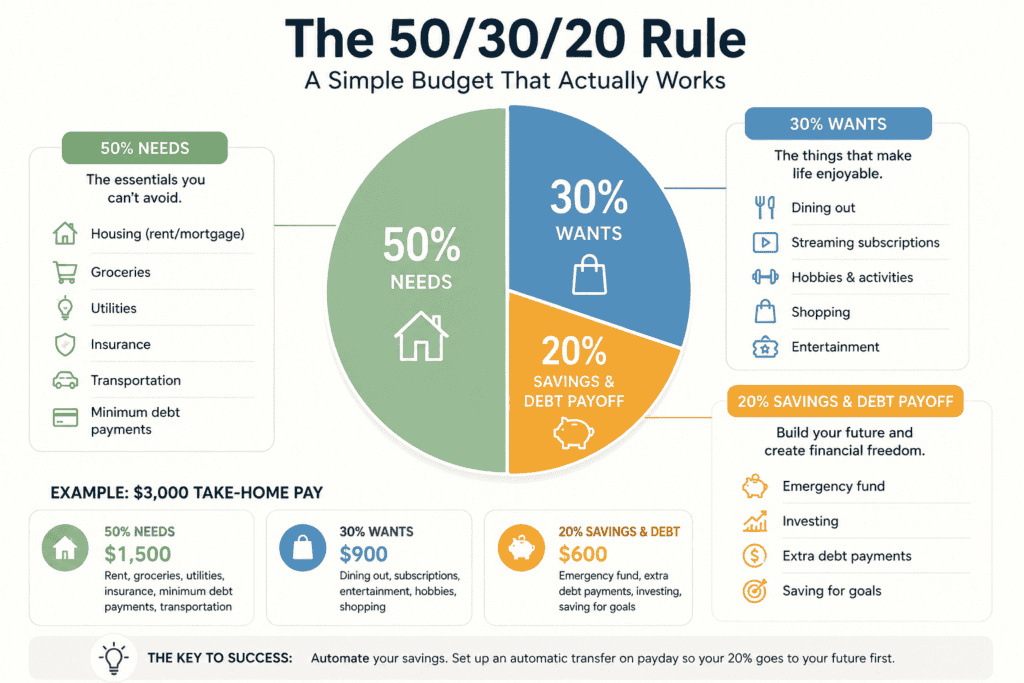
The rule splits your after-tax (take-home) income into three broad categories:
- 50% for Needs — the things you genuinely can’t avoid: rent or mortgage, groceries, utilities, insurance, minimum debt payments, transportation
- 30% for Wants — everything that makes life enjoyable but isn’t strictly necessary: eating out, streaming subscriptions, hobbies, shopping
- 20% for Savings & Debt Payoff — building an emergency fund, saving for goals, investing, or paying extra toward debt beyond the minimum
That’s the entire method. No tracking every coffee or gas station stop — just three buckets that add up to 100% of your income.
A Real Example With Numbers
Let’s say your monthly take-home pay is $3,000. Here’s how the split would look:
- Needs (50%): $1,500 — rent, groceries, utilities, insurance, minimum debt payments
- Wants (30%): $900 — dining out, subscriptions, entertainment, shopping
- Savings & Debt (20%): $600 — emergency fund, extra debt payments, investing
50/30/20 Budget Calculator
Enter your monthly take-home income to see how the 50/30/20 rule would divide your money between needs, wants, and savings or debt payoff.
When I ran my own numbers through this for the first time, my rent alone was $1,350 on a $3,000 take-home paycheck — before groceries, insurance, or a single utility bill. My "Needs" category came out closer to 58%, not the tidy 50% the rule promises. My first reaction, honestly, was to assume I was doing something wrong. I wasn't. I was just living in a city where rent eats a bigger slice than the formula assumes, and that's a completely different problem than "bad budgeting." That's actually a really common outcome, and it doesn't mean the method has failed you — it means you've just found useful information about where your budget is tightest.
What Counts as a "Need" vs a "Want"?
This is where most people get stuck, because the line isn't always obvious. A rough way to think about it:
- Need: Would something bad happen if you stopped paying this? (Eviction, no electricity, no way to get to work)
- Want: Would life just be less enjoyable, but nothing would actually break?
Some tricky examples:
- Basic groceries = Need. Takeout food = Want.
- A basic phone plan = Need. The newest phone model = Want.
- Minimum credit card payment = Need. Extra payments beyond the minimum = Savings/Debt category (the good kind).
- Basic transportation to work = Need. Upgrading to a nicer car than necessary = Want.
There's no perfect universal answer here — some categories genuinely depend on your situation. The goal isn't to be philosophically perfect about every line item, it's to get a realistic picture of your spending.
What to Do If Your Percentages Don't Match
In high cost-of-living areas, it's extremely common for "Needs" to take up 60-70% instead of 50%. If that's you, you have a few honest options:
- Adjust the ratio to something more realistic, like 65/20/15, and treat 50/30/20 as a long-term goal rather than a rule you have to hit this month
- Look for ways to reduce fixed costs — a roommate, a cheaper phone plan, renegotiating insurance
- Increase income where possible, which is often more realistic than trying to shrink already-tight essential expenses
The point of the method is awareness, not guilt. If your numbers don't match the "ideal" split, that's useful information, not a failure. I'd honestly rather see someone run an honest 60/25/15 split than force a 50/30/20 that only works by underestimating their own rent.
Why This Method Works So Well for Beginners
It's simple enough to actually maintain. Many people give up on detailed budgets within a few weeks because tracking 15 categories is exhausting. Three categories is much easier to keep up with long term.
It still leaves room for enjoyment. Because "Wants" has its own dedicated slice, you're not trying to cut out everything fun — you're just capping it at a reasonable amount.
It builds savings into the plan automatically instead of treating savings as "whatever's left over," which for most people ends up being nothing.
How to Set It Up This Week
- Calculate your monthly take-home pay
- Multiply it by 0.50, 0.30, and 0.20 to get your three target numbers
- List your current fixed expenses and see how close you are to the 50% "Needs" target
- Decide on a realistic amount for "Wants" that you'll actually track (even loosely)
- Set up an automatic transfer for the "Savings & Debt" portion on payday, so it happens before you have a chance to spend it
That last step — automating the savings piece — is honestly the part that makes this method work in practice rather than just on paper. If the money moves automatically, you're not relying on willpower at the end of the month.
Final Thought
The 50/30/20 rule isn't a perfect fit for everyone, especially in expensive cities or with irregular income. But as a starting framework, it gives you a simple way to think about your money without needing an app, a spreadsheet, or hours of tracking. Start with the ratio, adjust it to your real numbers, and refine it as you go.
Disclaimer: This article is for general educational purposes only and is not personalized financial advice. Everyone's financial situation is different — consider speaking with a licensed financial professional for advice specific to your circumstances.